How to Test for Radon in the Basement
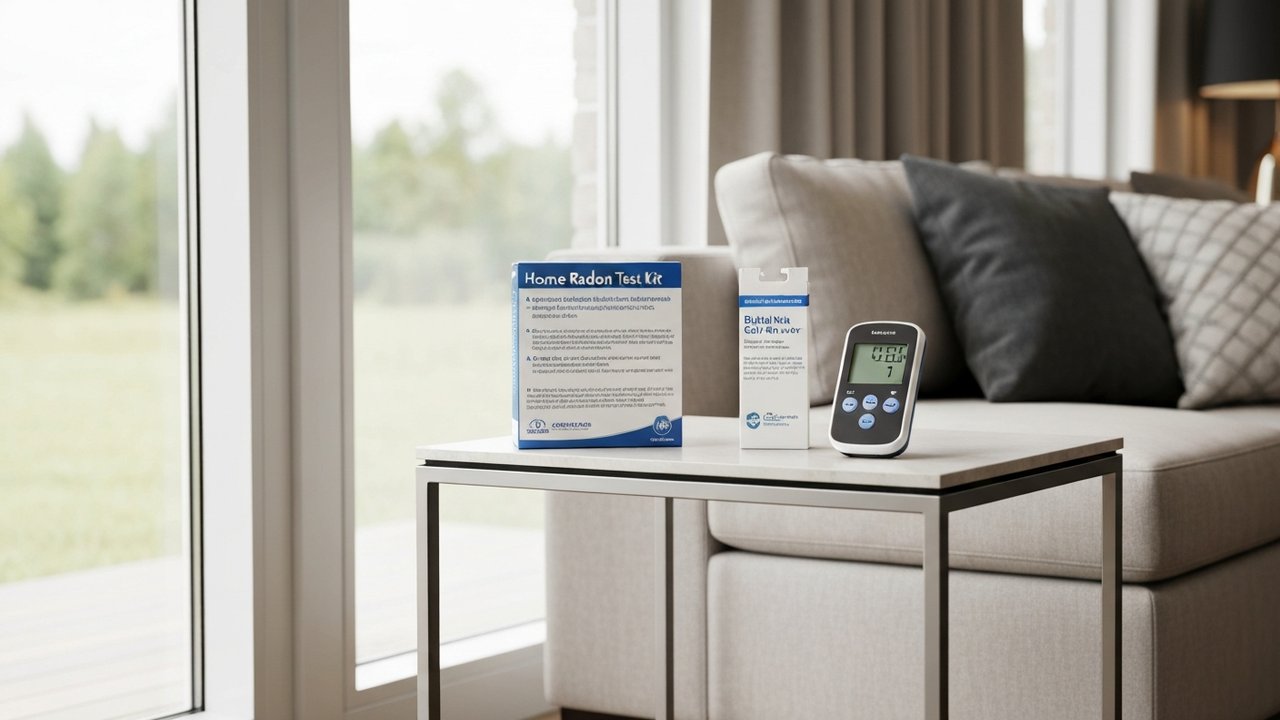
Why basements get the highest readings
Radon forms when uranium in soil and rock breaks down. As a gas, it migrates upward through the earth and into buildings through any opening it can find: cracks in poured concrete, gaps where the slab meets the foundation wall, sump pits, floor drains, and penetrations around pipes. A house typically sits at slightly lower air pressure than the soil beneath it, which creates a gentle pull that draws soil gas, including radon, up through those openings.
Because radon enters from below, it tends to concentrate at the lowest point in the building. Basements routinely show the highest radon levels in a home, often well above readings on the floors above them. If your basement is finished and someone uses it as a bedroom, office, or regular living space, that room can be where your household accumulates the most exposure, not just where the highest number appears on a test.
This pattern holds regardless of region. The EPA’s Zone 1 map, which covers much of the Mountain West, upper Midwest, and Appalachian belt, flags areas with the most homes above the action level. But high basement readings turn up in every state, including coastal and southern areas where homeowners sometimes assume they are in the clear. Soil composition, foundation construction, and ventilation all play a role, and there is no substitute for actually measuring.
Short-term versus long-term tests: which do you need?
Two categories of tests are available, and the right choice depends on your situation.
Short-term charcoal tests run 48 to 96 hours. You place a small canister of activated charcoal, close it after the exposure window, and mail it to a lab. Results come back within a few days. These are useful for initial screenings, real estate transactions with tight deadlines, and confirming that a newly installed mitigation system brought levels down. The limitation is precision: radon fluctuates with weather, wind, HVAC cycles, and how tightly the house is closed. A two-day snapshot can land noticeably above or below the true annual average.
Long-term alpha track detectors run for at least 90 days, and many testing authorities prefer a full 6 to 12 months. A small piece of plastic inside the device records each radon decay event as a tiny physical mark. The lab counts those marks and returns a time-averaged result that better reflects actual annual exposure, which is the basis for the EPA action level.
For a first test, a short-term charcoal kit is a reasonable and inexpensive starting point. If the result comes back above 4 pCi/L, the standard protocol is to follow up with a second test before committing to mitigation, unless the number is very high. For a definitive baseline without the follow-up step, a long-term alpha track test is worth the wait. The full comparison is at short-term vs long-term radon tests.
Setting up the test correctly
Placement errors are the most common way homeowners get a reading that does not reflect actual conditions. A few straightforward rules cover most situations.
Height: Place the kit between 20 inches and 6 feet above the floor. Anywhere from about knee height to chest height works. Lower than 20 inches and you risk measuring a dead-air zone; higher than 6 feet and you are testing air that differs from what people breathe at normal activity levels.
Distance from drafts: Keep at least a foot from exterior walls, windows, and HVAC supply or return vents. Moving air dilutes radon around the sensor and can produce a reading that is lower than what the room holds during still conditions.
Not in corners or near entry points: Radon can pool in low-circulation corners, and placing a kit directly over a sump pit, floor drain, or large crack will capture an artificially elevated local concentration rather than the room average.
Where people actually are: If the basement has a finished room where someone sleeps or works, test there rather than in the unfinished mechanical room around the corner. The point is to measure exposure, not just the building.
Closed-house conditions: During the test, keep exterior windows and doors closed except for normal entry and exit. Ventilating the basement before or during the test flushes out radon and returns an artificially low number. The EPA specifies closed-house conditions for at least 12 hours before a short-term test begins and throughout the test itself.
For more on positioning, including how continuous electronic monitors differ from passive kits, see where to place a radon detector.
Where to get a test kit
Start with your state radon program. Most states offer charcoal test kits through health departments or university extension programs, often for free or a nominal fee of $1 to $10. These kits ship to accredited labs, and the results are reliable. Search for “[your state] radon test kit” or visit your state health department’s environmental health page to find the offer.
If you prefer to buy directly, both charcoal canisters and alpha track detectors are widely available online. Look for a kit whose included lab is accredited through NRPP (the National Radon Proficiency Program, run by the Indoor Environments Association, which was previously called AARST-NRPP). Accreditation means the lab is tested for accuracy on an ongoing basis.
For a short-term charcoal screening: Check price on Amazon. For a long-term alpha track baseline: Check price on Amazon.
What your results mean and what to do next
Your lab report will give you a number in pCi/L (picocuries per liter). Here is how to read it:
- Below 2 pCi/L: Near the U.S. indoor average. Some risk exists at any level (the EPA is explicit that no threshold is risk-free), but this is not considered an immediate concern.
- 2 to 4 pCi/L: The EPA suggests considering mitigation in this range. The risk is real and measurable; fixing a home at this level is not required but is reasonable, especially if the basement is used heavily.
- 4 pCi/L or above: The EPA action level. The agency recommends fixing your home, and the U.S. Surgeon General has specifically urged Americans to take action at this level.
- 10 pCi/L or above: Significant elevation. Act promptly. A level this high warrants calling a certified mitigator rather than waiting for a follow-up test.
For international context: the WHO sets a reference level of 100 Bq/m3 (roughly 2.7 pCi/L), and Health Canada’s guideline is 200 Bq/m3 (about 5.4 pCi/L). The U.S. EPA action level of 4 pCi/L falls between these benchmarks.
If your basement result meets or exceeds 4 pCi/L, the standard solution is a professionally installed mitigation system. The most common approach is sub-slab depressurization: a fan pulls radon from under the floor and vents it above the roofline before it reaches living space. Systems like this typically reduce radon by a large margin, often bringing levels well below the action level. For pricing and what to expect from the installation process, see radon mitigation cost.
One practical note: a single short-term test above the action level is worth confirming with a second test before scheduling a contractor, unless the number is very high. Two tests above 4 pCi/L, or one result above 10 pCi/L, is a clear signal to move forward.
FAQ
Does the EPA recommend testing the basement specifically? Yes. EPA guidance calls for testing the lowest livable area of the home, which for most houses means the basement. If your basement is finished and used regularly, that is the priority space. Unfinished storage rooms and garages are not considered livable areas for testing purposes, so test where people actually spend time.
Can I test my basement myself, or do I need to hire someone? You can do it yourself. Charcoal canisters and alpha track detectors are designed for homeowner use, follow the same protocols as professional screening tests, and are accepted by most state programs. Professional measurement is sometimes required for real estate disclosure in certain states, but for a personal baseline, a quality DIY kit is entirely appropriate. Make sure the kit sends samples to an NRPP-accredited laboratory.
My short-term result came back above 4 pCi/L. Do I need to act immediately? Not immediately, but do not ignore it. The EPA protocol recommends a second test before committing to mitigation: either a second short-term test conducted under closed-house conditions or a 90-day long-term test. If both confirm the level is at or above 4 pCi/L, contact a contractor certified through AARST-NRPP (now the Indoor Environments Association). If the first result was 10 pCi/L or higher, prioritize getting mitigation scheduled rather than waiting for a second test.
How often should I retest after getting a result? If your initial test comes back below 4 pCi/L and you are not making major changes to the home, retesting every two years is a sensible routine. After any significant renovation that affects the foundation, basement slab, or ventilation system, retest. If you install a mitigation system, the EPA recommends retesting within 24 hours to 30 days of installation to confirm it is working as expected.
Not sure where your home stands? Try the free Radon Risk Calculator to see what your level means and what to do next.
Related guides
How Much Does a Radon Test Kit Cost?
A plain-English breakdown of what radon test kits actually cost, from free state programs to charcoal canisters, alpha-track kits, and professional testing.
Read the guide →How to Use a Radon Test Kit Correctly
Step-by-step instructions for using a short-term charcoal radon test kit correctly, from closed-house conditions to mailing the sample to the lab.
Read the guide →Radon Testing for New Construction Homes
Why new construction homes aren't automatically radon-free, when to test, and what to do if your RRNC-equipped home still reads above 4 pCi/L.
Read the guide →The only way to know your radon level is to test
Radon is invisible and odourless, and the only way to know your home's level is a test. An inexpensive home test kit is the simplest place to start. See our picks and how to read the result.
See the best radon test kits →