Is Radon Testing Really Necessary?
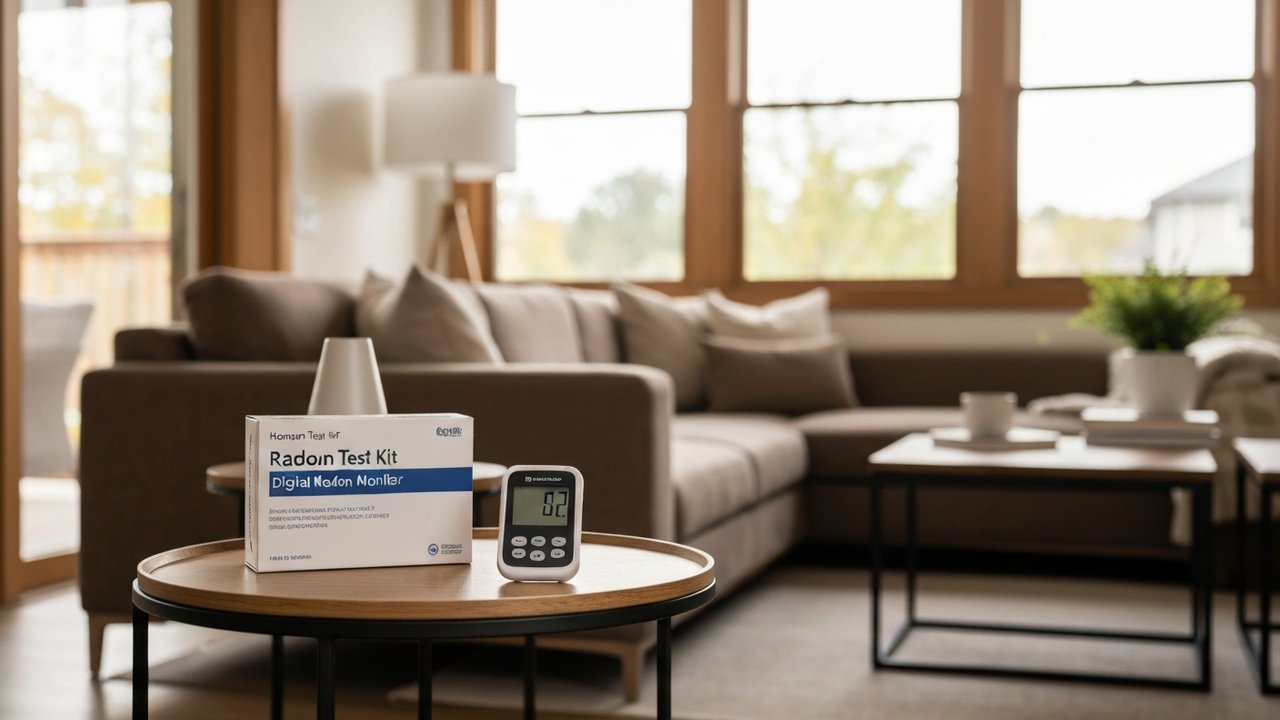
Testing matters regardless of your zip code
Many homeowners skip radon testing because their county falls into an EPA “Zone 2” or “Zone 3” area on the radon potential map, categories labeled as having lower predicted average indoor concentrations. Or they figure that if the neighbor’s house tested fine, theirs probably is too. Neither shortcut holds.
Radon concentrations depend on your specific soil and bedrock, how your foundation was constructed, how your home is pressurized relative to the ground beneath it, and how well it is ventilated. Two houses built side by side can read very differently. The EPA explicitly cautions that its zone maps should not be used to decide whether individual homes need testing; they were designed for building codes and state policy, not for a homeowner making a skip-or-test call.
The number that matters is this: roughly 1 in 15 US homes has radon at or above the 4 pCi/L action level. That is a nationally common hazard, not a regional specialty. If any other household risk showed up in roughly 1 of every 15 homes, routine testing would be assumed rather than debated. Radon is not different in that respect; it just happens to be invisible.
You cannot feel radon, and that is the problem
Radon has no color, smell, or taste. It does not make your eyes water or cause a cough. There is no warning signal of any kind. The health damage from radon, specifically the repeated cellular injury to lung tissue from inhaling radon decay products, builds up over years. By the time lung cancer is diagnosed, the exposure has been accumulating for a long time.
This is why the U.S. Surgeon General issued a national health advisory urging Americans to test their homes. The advisory makes no exception for new construction, lower-radon regions, or homes where nothing seems wrong. The warning exists because radon’s invisibility is exactly what makes it dangerous when left unmeasured.
The U.S. EPA attributes roughly 21,000 lung cancer deaths each year to radon exposure, making it the second leading cause of lung cancer overall and the leading cause among people who have never smoked. The World Health Organization classifies radon as a confirmed human carcinogen and sets a reference level of 100 Bq/m3, while Health Canada uses an action guideline of 200 Bq/m3 (roughly 5.4 pCi/L) and makes the same testing recommendation. These agencies agree on the underlying science. A test is the minimum step for acting on their combined guidance.
New homes are not exempt
A common assumption is that newer construction is inherently safer. Some modern building practices do reduce radon entry: poured concrete slabs with fewer cold-joint gaps, passive radon venting roughed into the structure, tighter foundations overall. Several states now require radon-resistant new construction features or testing before a certificate of occupancy is issued.
But those features reduce the likelihood of high levels; they do not guarantee them. A house built in 2022 can still have elevated radon, particularly if the passive vent stack was never connected to an active fan, if the site has especially radon-rich soil, or if construction left gaps that were not caught. If your home was built after 2000 and has never been tested, you still do not know your level.
What testing actually costs
This is the part that surprises most people. Professional radon measurements, typically a 48-hour continuous electronic monitor or electret device placed by a certified tester, run roughly $150 to $300 depending on your area. That is a one-time cost with years of value.
More accessible are DIY activated-charcoal short-term kits. A quality kit costs about $15 to $30 at hardware stores or online, and you mail the canister to a certified laboratory at the end of the test period, usually two to seven days. Check price on Amazon
Before buying a kit, check your state radon program first. The EPA maintains a list of state radon contacts, and many states subsidize kits or provide promo codes for discounts at hardware chains. Some mail kits at no cost to residents. Your state may have already paid for your first test.
For a breakdown of short-term versus long-term kits and when each type makes sense, see our guide on short-term vs long-term radon tests.
When to test, and when to retest
If your home has never been tested, test now. Beyond that first measurement, the EPA recommends retesting every two years in homes that come back below the action level. Major renovations are another trigger. Finishing a basement, sealing a crawl space, or adding an addition can shift how your home breathes, which changes radon entry pathways and pressure dynamics. Test again after any significant structural work.
Real estate transactions are a common occasion as well. Testing is standard in higher-radon regions and increasingly expected elsewhere. If you are buying a home and no radon test is on file, request one before closing. The cost is trivial compared to what you are about to spend on the house.
If your home already has a mitigation system, do not assume the work is permanently done. Fans wear out over time, pipe connections can loosen, and a system that once brought levels well below 4 pCi/L may no longer be performing as designed. The small pressure gauge (manometer) on the pipe shows whether the fan is running, but only an actual radon measurement tells you whether the levels are still in range.
What skipping the test actually risks
A home with radon above the EPA action level is not an emergency. What it is, is a risk that compounds quietly over time. Elevated exposure year after year is very different from a single high-reading weekend. If you live for a decade at 8 pCi/L without testing or reducing it, you have accumulated far more lifetime exposure than someone who discovered that same level, installed a mitigation system, and brought the home below 2 pCi/L. The decision to test is, in practical terms, a decision about how much cumulative risk you are comfortable carrying without knowing.
If a test comes back elevated, the path forward is clear. Radon mitigation has a real cost, typically $800 to $2,500 for a professionally installed sub-slab depressurization system, but that cost is bounded and the fix is durable. A system installed by a contractor certified through AARST-NRPP (the National Radon Proficiency Program) can reduce radon by up to 99 percent in many homes. The solution exists; the test simply tells you whether you need it.
FAQ
Is radon testing required by law in the US? Federal law does not require homeowners to test. Some states mandate testing at the point of sale or for new construction, and a handful of local jurisdictions have adopted testing requirements. In most of the country, testing is strongly recommended and widely available but not legally required. That does not make it practically optional if reducing long-term lung cancer risk is a goal.
Can I test my home myself, or do I need a professional? Both approaches work. DIY activated-charcoal kits give valid results when used correctly and sent to a certified laboratory. Long-term tests, those lasting 90 days or more, give a more representative annual average than short-term kits. Professional testing is sometimes required for real estate transactions. For a first measurement in your own home, a quality DIY kit is a reasonable and affordable starting point. See our picks for the best radon test kits.
My county is not listed as high-risk. Should I still test? Yes. County and state zone maps reflect regional averages drawn from aggregate data. They were designed for policy and building codes, not for individual homeowners deciding whether to skip a measurement. Elevated radon has been found in homes in every US state. Your specific soil, foundation type, and ventilation patterns determine your reading, not your zip code or your neighbor’s result.
How do I know if a radon test kit is legitimate? Look for kits that send samples to a laboratory accredited through AARST-NRPP, specifically the National Radon Laboratory Proficiency Program (NRLPP). Reputable brands include Airchek and PRO-LAB, both of which use NRLPP-accredited labs. Your state radon office may also maintain a list of approved labs and approved kit suppliers. Kits sold at major hardware stores and through state programs are generally from accredited suppliers.
Not sure where your home stands? Try the free Radon Risk Calculator to see what your level means and what to do next.
Related guides
How Much Does a Radon Test Kit Cost?
A plain-English breakdown of what radon test kits actually cost, from free state programs to charcoal canisters, alpha-track kits, and professional testing.
Read the guide →How to Use a Radon Test Kit Correctly
Step-by-step instructions for using a short-term charcoal radon test kit correctly, from closed-house conditions to mailing the sample to the lab.
Read the guide →Radon Testing for New Construction Homes
Why new construction homes aren't automatically radon-free, when to test, and what to do if your RRNC-equipped home still reads above 4 pCi/L.
Read the guide →The only way to know your radon level is to test
Radon is invisible and odourless, and the only way to know your home's level is a test. An inexpensive home test kit is the simplest place to start. See our picks and how to read the result.
See the best radon test kits →