Radon Detectors vs Test Kits: Which Should You Use?
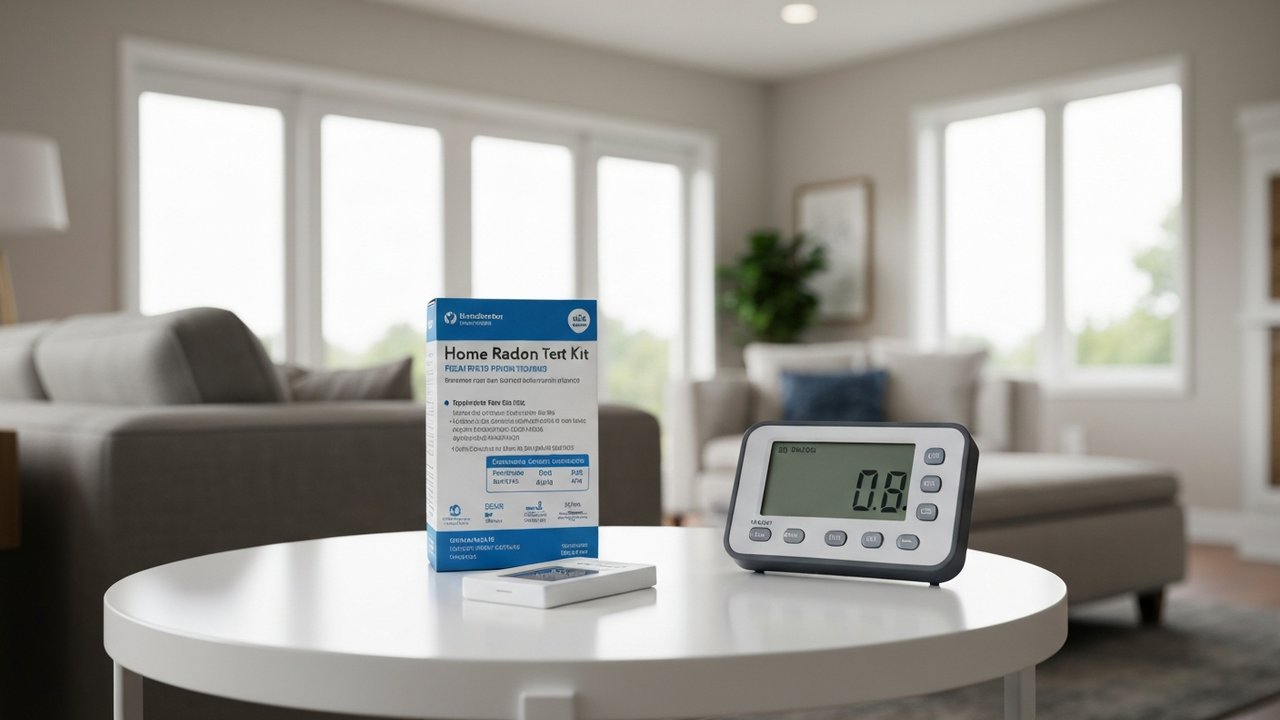
Two tools, different jobs
Radon testing started as a mail-in process. You place a passive device in the lowest livable level of the home, leave it for a required period, seal it, and send it to a certified lab. The result, in picocuries per liter, is what the EPA, state radon offices, and real estate attorneys actually require.
Electronic monitors are a newer category. They use ionization chambers or similar sensors to sample air continuously and display averaged readings on a screen or phone app. The appeal is straightforward: you see something today rather than waiting for a lab envelope.
Both have legitimate uses, and which one fits depends on your situation. New to the topic? What is radon and is it dangerous covers how radon enters homes and what the health risk looks like.
Short-term passive test kits
Short-term kits are the most widely used option for initial screening, and they are what most state radon programs distribute for free or at very low cost. The most common type uses activated charcoal: a small canister that passively absorbs radon during the exposure period. EPA protocol calls for a minimum 48-hour exposure, and most kits run 48 to 96 hours. You place the canister in the lowest livable area, keep windows and exterior doors closed (except for normal entry and exit), then seal and mail the kit within 24 hours of collection.
Kits typically cost $15 to $40 including lab analysis and prepaid return shipping, and results come back within a few business days. Many state programs sell certified kits for $10 to $15; check your state’s radon program before buying from a retailer.
The limitation is that a 48-hour snapshot may not capture your long-run average. Radon fluctuates with weather, season, and ventilation patterns. For this reason, the EPA treats a short-term test as a screening step. A result at or above 8 pCi/L generally justifies moving straight to mitigation. Between 4 and 8 pCi/L, a follow-up long-term test before committing to a system is often the better call. Below 4 pCi/L, the risk is lower, but a long-term test still provides more confidence than a single 48-hour reading.
If you want to browse certified kit options, see our best radon test kits roundup. If you prefer to order directly: Check price on Amazon
Long-term passive test kits
Long-term tests use a different technology: an alpha track detector. Inside a small plastic container is a disc of special polymer film. As radon decays, it releases particles that leave microscopic damage tracks on the disc. After at least 90 days (and sometimes up to a year), the disc goes to a lab where technicians count the tracks under a microscope and calculate your average concentration.
That extended averaging window is the whole point. Radon is not constant. It tends to climb in winter when homes are sealed up, and it can spike with changes in barometric pressure. A 90-day or longer test smooths out all of that variability and gives you a picture of your actual long-term exposure, which is what matters for health risk assessment.
Long-term alpha track kits cost roughly $25 to $50, and while they are less common at hardware stores than charcoal kits, most certified labs and state programs carry them. A short-term test at closing is the norm in real estate, but a full heating-season average gives much more confidence before committing to a mitigation decision.
Electronic continuous monitors
Electronic monitors have become popular for good reasons. Devices in this category display radon levels averaged over the last hour, 24 hours, or 7 days on a screen or through a phone app. Some models also track temperature, humidity, and CO2 in the same unit.
What they do well: they reveal how radon behaves in your home across seasons. If you have a mitigation system, a continuous monitor is a practical way to catch a failing fan or degraded suction well before your next scheduled test. They also give renters who cannot install permanent systems some visibility into what they are breathing.
What they do less well: they are not yet equivalent to a certified lab result for formal purposes. Real estate transactions, state health department recommendations, and EPA guidance all call for a lab-analyzed passive test, not a monitor reading. Electronic monitors also need calibration checks over time, and accuracy varies considerably by price point. Look for devices that meet performance criteria established by AARST-NRPP (C-NRPP in Canada), the national radon proficiency program. Budget units in the $50 to $80 range may display numbers but lack the precision of higher-quality models or lab-analyzed tests.
Good continuous monitors from reputable brands run $150 to $300 or more. Check price on Amazon
When each type fits
First test, no previous result: Start with a short-term charcoal kit from your state program or a certified lab. Place it in the lowest level you use regularly. If the result is at or above the EPA action level of 4 pCi/L, you have a clear signal to investigate mitigation or confirm with a long-term test first. Below 2 pCi/L, the urgency is low, but a long-term test is still worthwhile before assuming you are in the clear.
Home sale or purchase: A lab-analyzed result from a certified passive kit or a professionally conducted measurement is what most real estate contracts specify. Electronic monitors do not meet this standard in most states. Confirm the required method with your agent or attorney before ordering any device.
After a mitigation system is installed: The EPA recommends a post-mitigation retest to confirm levels actually dropped. A short-term charcoal kit placed right after install is the standard approach. A continuous monitor is a useful follow-on tool: place one in the basement to watch for any future degradation of the system.
Ongoing awareness: A long-term alpha track test placed during the heating season gives the most accurate annual average. After that baseline, periodic short-term retests every two years plus a continuous monitor provides layered coverage that the EPA suggests for homes in higher-radon regions.
Whatever type you use, the benchmark is the EPA action level of 4 pCi/L, backed by a U.S. Surgeon General advisory urging all Americans to test. For reference, the WHO sets a reference level of 100 Bq/m3 (roughly 2.7 pCi/L) and Health Canada’s guideline is 200 Bq/m3 (about 5.4 pCi/L).
For more detail on how to prepare your home and set up proper test conditions, see how to test your home for radon.
FAQ
Can I use an electronic radon monitor for a home sale? In most cases, no. Standard real estate contracts and state health department guidance require a lab-analyzed result from a certified passive test kit or a test conducted by a measurement professional. Electronic monitors do not satisfy that requirement. Use a charcoal canister or alpha track kit sent to a certified lab for any transaction where the result needs to hold up for disclosure purposes.
How long do I leave a charcoal test kit in my home? EPA protocol requires at least 48 hours under closed-house conditions: windows and exterior doors kept shut except for normal entry and exit. Most charcoal kits are designed for 48 to 96 hours. After that window, seal the kit and mail it to the lab within 24 hours. Do not leave a charcoal kit out longer than the instructions specify; the charcoal saturates and the result becomes unreliable.
Are inexpensive electronic radon detectors accurate? Accuracy varies widely. Entry-level monitors in the $50 to $80 range may display plausible-looking numbers without the precision of higher-end units. Look for devices meeting AARST-NRPP performance criteria, and treat any monitor reading as a trend indicator rather than a substitute for a certified lab result.
Should I test in winter or summer? Winter is generally the better time for a baseline test. Cold weather keeps homes closed up, which tends to drive radon concentrations higher. Testing under those conditions gives you a conservative picture of your peak exposure. A level that looks acceptable in January is unlikely to look worse in July.
Not sure where your home stands? Try the free Radon Risk Calculator to see what your level means and what to do next.
Related guides
How Much Does a Radon Test Kit Cost?
A plain-English breakdown of what radon test kits actually cost, from free state programs to charcoal canisters, alpha-track kits, and professional testing.
Read the guide →How to Use a Radon Test Kit Correctly
Step-by-step instructions for using a short-term charcoal radon test kit correctly, from closed-house conditions to mailing the sample to the lab.
Read the guide →Radon Testing for New Construction Homes
Why new construction homes aren't automatically radon-free, when to test, and what to do if your RRNC-equipped home still reads above 4 pCi/L.
Read the guide →The only way to know your radon level is to test
Radon is invisible and odourless, and the only way to know your home's level is a test. An inexpensive home test kit is the simplest place to start. See our picks and how to read the result.
See the best radon test kits →