The Best Home Radon Detectors
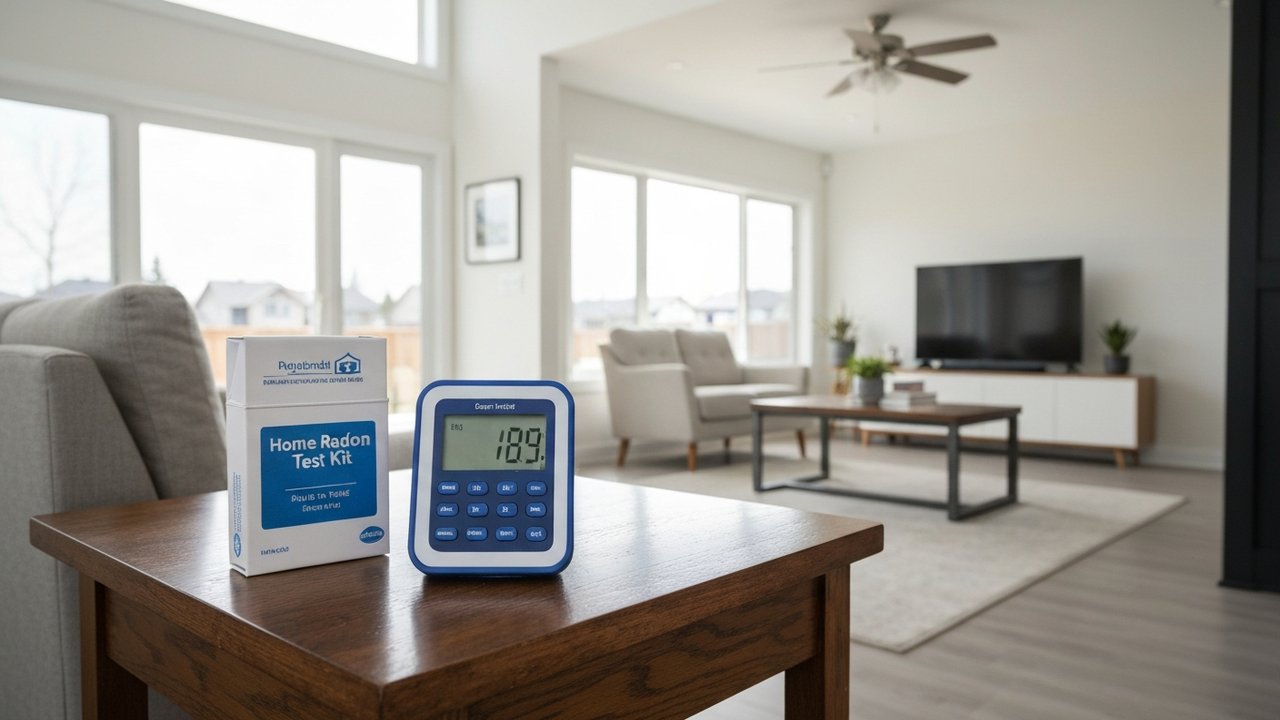
Two types of detectors, two very different tools
The word “detector” covers a lot of ground in the radon world, from a $15 charcoal canister to a $250 Wi-Fi gadget, and the right choice depends on what you actually need to know.
Passive test kits sit in the room for a set period, absorbing radon particles, and then get mailed to an accredited lab. Charcoal canisters, the most common short-term option, stay out for 2 to 7 days. Alpha track detectors are designed for 90 days to a year and return a more reliable long-term average. Kits are inexpensive, generally $15 to $40 including lab analysis, but they give you a one-time snapshot, not ongoing data.
Continuous electronic monitors measure radon constantly, display a rolling average on a screen or app, and stay in your home indefinitely. They cost more upfront, usually $100 to $300, but they show how levels change with the seasons, after you run a fan, or following mitigation work.
For most homeowners making a first test, a passive kit is the smarter starting point: lower cost, lab-verified result, and good enough to decide whether action is needed. A continuous monitor adds real value if you want to watch your home over time. See our comparison of radon detectors and test kits for a closer look at the trade-offs.
Start here: check your state program first
Before you buy anything, look up your state radon program. Most states distribute free or very low-cost test kits through the state health department or a university extension office, with some programs charging just a few dollars for a lab-analyzed charcoal test. Search for “[your state] free radon test kit” or find your state contact through the EPA’s state radon offices page.
These kits use labs accredited under EPA protocols. A free state kit is not a lesser option. It is the same science as anything sold online, and the results are fully valid for making decisions. If your state also has a list of certified testers and mitigators, that page is worth bookmarking for later.
What to look for in a continuous monitor
If you decide to buy an electronic monitor, a handful of specs actually matter.
Validated accuracy. The device should have been compared against professional-grade instruments in a controlled setting. Airthings publishes these results for their lineup. A monitor with no published accuracy data is a guess.
Reporting in pCi/L. It should display the US unit so you can compare your reading directly to the EPA action level of 4 pCi/L. Devices that show only a colored light or a vague “low/medium/high” indicator make it hard to know where you actually stand.
Averaging period. Radon levels fluctuate naturally by a factor of two or three within a single day, driven by temperature, barometric pressure, and how tightly the house is sealed. A device averaging over 7 days or 30 days is far more useful than one reporting hour-by-hour swings. Look for a device that shows both a short-term and a longer-term average.
Display versus app. Some monitors show readings on a screen you can glance at without picking up your phone. Others rely entirely on a smartphone app for anything beyond a basic indicator. Both approaches work. Think about which you will actually check on a regular basis. App-based devices can send alerts when levels rise and store months of history, which is genuinely useful, but only if you use the app.
No subscription required. Some budget monitors gate historical data or alerts behind a paid monthly service. Read the product description before buying.
Top picks
For a standalone, no-app monitor: The Airthings Corentium Home is the most widely recommended option for US homeowners. It shows short-term and long-term averages in pCi/L on a simple display, runs on batteries, and requires no Wi-Fi, account, or subscription. Airthings has published side-by-side comparisons against professional-grade instruments showing close agreement. It is not a cheap device, but it is the one radon professionals most consistently recommend when homeowners ask about continuous monitoring. Check price on Amazon
For app-connected monitoring: The Airthings Wave Plus connects to your home Wi-Fi and the Airthings app, which shows historical charts, sends alerts when levels rise, and lets you check readings remotely. It also monitors CO2, humidity, and volatile organic compounds. The radon sensor is the same generation as the Corentium. If tracking data over time matters to you, the app adds real usefulness. Check price on Amazon
For a cross-check or one-time confirmation: A charcoal canister kit from any accredited lab is inexpensive and gives you a lab-certified number alongside whatever your electronic monitor shows. Kits from providers such as Alpha Energy Laboratories and AccuStar are widely available for $15 to $35 with lab analysis included. Your state program may offer the same thing for less.
For more options in the passive kit category, our best radon test kits guide covers charcoal and alpha track options in more detail.
Where to put the detector
Placement matters more than most people expect, and a poorly placed device can mislead you in either direction.
Put it in the lowest level of the home you regularly occupy. A finished basement where you spend time is the right location. If you have no basement, or if the basement is unfinished and rarely used, place it on the first floor. Do not put it in a crawl space, attic, kitchen, bathroom, or laundry room, where humidity, exhaust fans, or ventilation skew the numbers.
Keep it at breathing height, between 2 and 6 feet off the floor, with at least a foot of clearance from the floor, ceiling, and exterior walls. Avoid placing it directly above or below a heating or cooling register.
For passive short-term tests, the EPA requires closed-house conditions: keep windows and doors closed except for normal entry and exit for at least 12 hours before the test starts and throughout the test period. Whole-house fans and window fans stay off. Normal air conditioning is fine.
Continuous monitors can stay in place year-round. Many homeowners notice that readings climb in winter, when tightly sealed homes trap more soil gas. That seasonal pattern is worth knowing about, and it is one reason a continuous monitor gives you a more complete picture than a single test.
What to do with your reading
The EPA action level is 4 pCi/L. At or above that, the agency recommends taking steps to reduce radon. The EPA also suggests considering action for readings between 2 and 4 pCi/L, because risk exists at any level and any reduction helps.
For comparison: Health Canada’s guideline is 200 Bq/m3 (about 5.4 pCi/L), and the WHO reference level is 100 Bq/m3 (about 2.7 pCi/L). Different countries land on slightly different numbers, but the underlying science agrees that lower is better. The U.S. Surgeon General has issued a national advisory urging Americans to test their homes and act on elevated results.
If your reading is elevated, the standard next step is a longer test to confirm the average (an alpha track detector over 90 to 365 days), followed by contacting a mitigator certified through AARST-NRPP. A very high short-term reading, above 8 to 10 pCi/L, is generally enough to act on without waiting for a longer confirmation. For full guidance on interpreting a result and deciding what to do next, see our guide on how to test your home for radon.
FAQ
Are home radon detectors accurate enough to rely on? The best continuous monitors, including the Airthings lineup, have been compared against professional instruments and shown close agreement in controlled testing. They are accurate enough to identify elevated levels and decide whether to investigate further or call a mitigator. For real estate transactions or post-mitigation verification, a professional measurement or accredited lab kit is the recognized standard.
How long does a continuous monitor take to give a reliable reading? Most devices need at least a week of data before their rolling average stabilizes. Airthings recommends waiting 30 days before acting on a number. Glance at the display in the first few days to confirm the device is working, but treat those early readings as preliminary.
Do I still need a test kit if I already have a continuous monitor? Not necessarily. A continuous monitor running for several months gives a solid picture of your annual average. That said, running a charcoal or alpha track kit alongside your monitor is a reasonable sanity check, especially after moving into a new home or following major renovations. If readings disagree significantly, a professional measurement can settle the question.
Can a radon detector show whether mitigation is working? Yes, and a continuous monitor is one of the more useful tools for that purpose. Set it up before mitigation work starts to get a baseline, then watch the readings drop after the fan and pipe are installed. Always follow up with a formal post-mitigation test as well, since a certified lab result carries more weight than a display reading when you need to document that levels dropped below the action level.
Not sure where your home stands? Try the free Radon Risk Calculator to see what your level means and what to do next.
Related guides
How Much Does a Radon Test Kit Cost?
A plain-English breakdown of what radon test kits actually cost, from free state programs to charcoal canisters, alpha-track kits, and professional testing.
Read the guide →How to Use a Radon Test Kit Correctly
Step-by-step instructions for using a short-term charcoal radon test kit correctly, from closed-house conditions to mailing the sample to the lab.
Read the guide →Radon Testing for New Construction Homes
Why new construction homes aren't automatically radon-free, when to test, and what to do if your RRNC-equipped home still reads above 4 pCi/L.
Read the guide →The only way to know your radon level is to test
Radon is invisible and odourless, and the only way to know your home's level is a test. An inexpensive home test kit is the simplest place to start. See our picks and how to read the result.
See the best radon test kits →